
Weather Girl
Published October 11, 2025
Yes, a disturbed, disorganized “hot mess” of a woman is center stage again. And yes, again, she is absolutely delightful.
This time, she is Stacey, the title character in Weather Girl, a one-woman show by Brian Watkins starring Julia McDermott, in performances at St. Ann’s Warehouse after a run at the Edinburgh Fringe Festival. In a script that rapidly careens from biting social commentary to philosophical examination of global warming, McDermott gives a compelling and chaotic performance that, in just 75 minutes, manages to examine and expose just some of the stifling social and professional constraints that bind women as well as global warming.
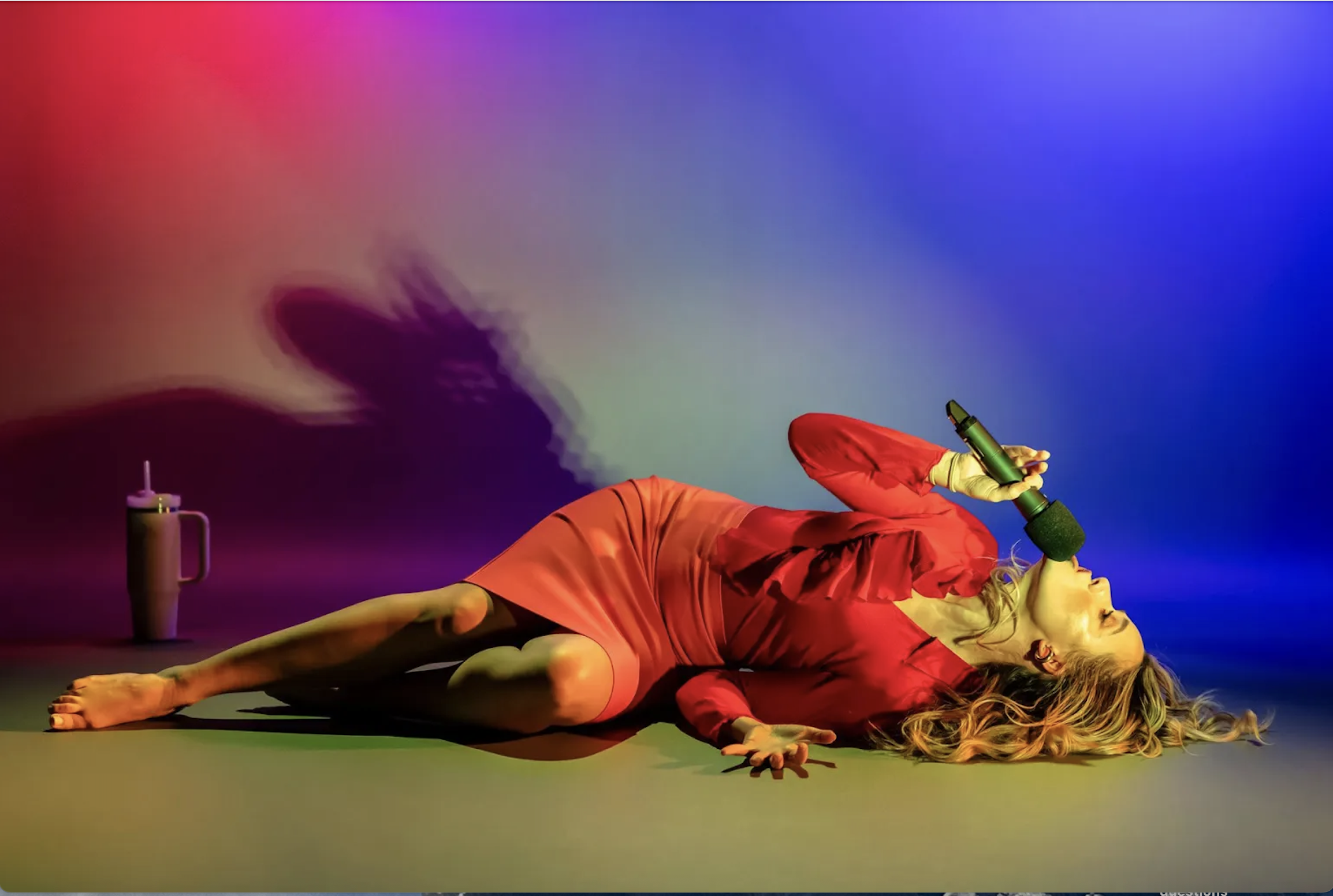
Comparisons to Fleabag are inevitable, especially in the first moments when McDermott introduces herself.Clad in a ruffled, curve-hugging, pink and red ensemble (the costume design is by Rachel Dainer-Best), she tells us she was “destined to be a weathergirl.” Talking in a childlike upspeak, Stacey is willingly twisting and shrinking herself to fit into the male gaze of the media, even when, while reporting on the California wildfires with “an enormous amount of sweat pooling in my Spanx.”
Stacey is complacent in the lies that build her life, which involves glossing over the reality of the weather, going on dates with people she hates and continuing her high-functioning alcoholism—the Stanley cup she is forever clutching is filled with prosecco, not water and she boasts of being a skilled drunk driver. (She’s been an alcoholic since college, she says matter-of-factly.)
It's the wildfires that trigger her undoing. After reporting on one of the fires — “I’m only smiling ’cause they tell you that’s the best way to get through these things” — she learns that the people inside the house in her background have died, and she is further shaken by a promotion and relocation to Phoenix, “the dryest city in America.” The next few hours involve Stacey deliberately crashing her date’s car and leaving him at the scene, an unhinged karaoke performance, a mystical maternal experience and an on-air meltdown of profoundly viral potential.
Directed by Tyne Rafaeli, Weathergirl moves briskly, with so much taking place that its brief running time is almost a surprise. Stacey’s personal descent, mirroring or serving as an allegory for the descent of the planet, is at times terrifying and at times bewildering to witness. The sound design by Kieran Lucas and the lighting by Isabella Byrd evoke her mental decline alongside that of the physical world around her.
Just what is taking place in her mind compared to the physical world becomes more difficult to discern — one-woman shows love unreliable narrators — as Watkins’ script moves into the metaphysical. Raised by foster parents, Stacey confronts her birth mother in a awkward subplot, with her mother symbolizing Mother Nature with talk of a miracle of nature being the salvation of the world.
The show’s cohesiveness unravels as the show progresses to intoxicated karaoke, dancing in a nightclub and the parking lot behind an El Pollo Loco, among other locations, while Stacey is forced to face the lies that are the foundation of her existence.
Whether or not Stacey warrants our attention for even one hour relies on McDermott’s performance. She is a profoundly flawed person — her decision to leave her tech bro date in his crashed car, then later hide him in the trunk of her own car is not resolved or forgiven — but one is left pondering how much of her life is confined to a cage of her own building and how much is the patriarchy has driven her to the state she is in.
The forecast might be sunny with a burst of insanity, but some clarity can be forecast in the future.