
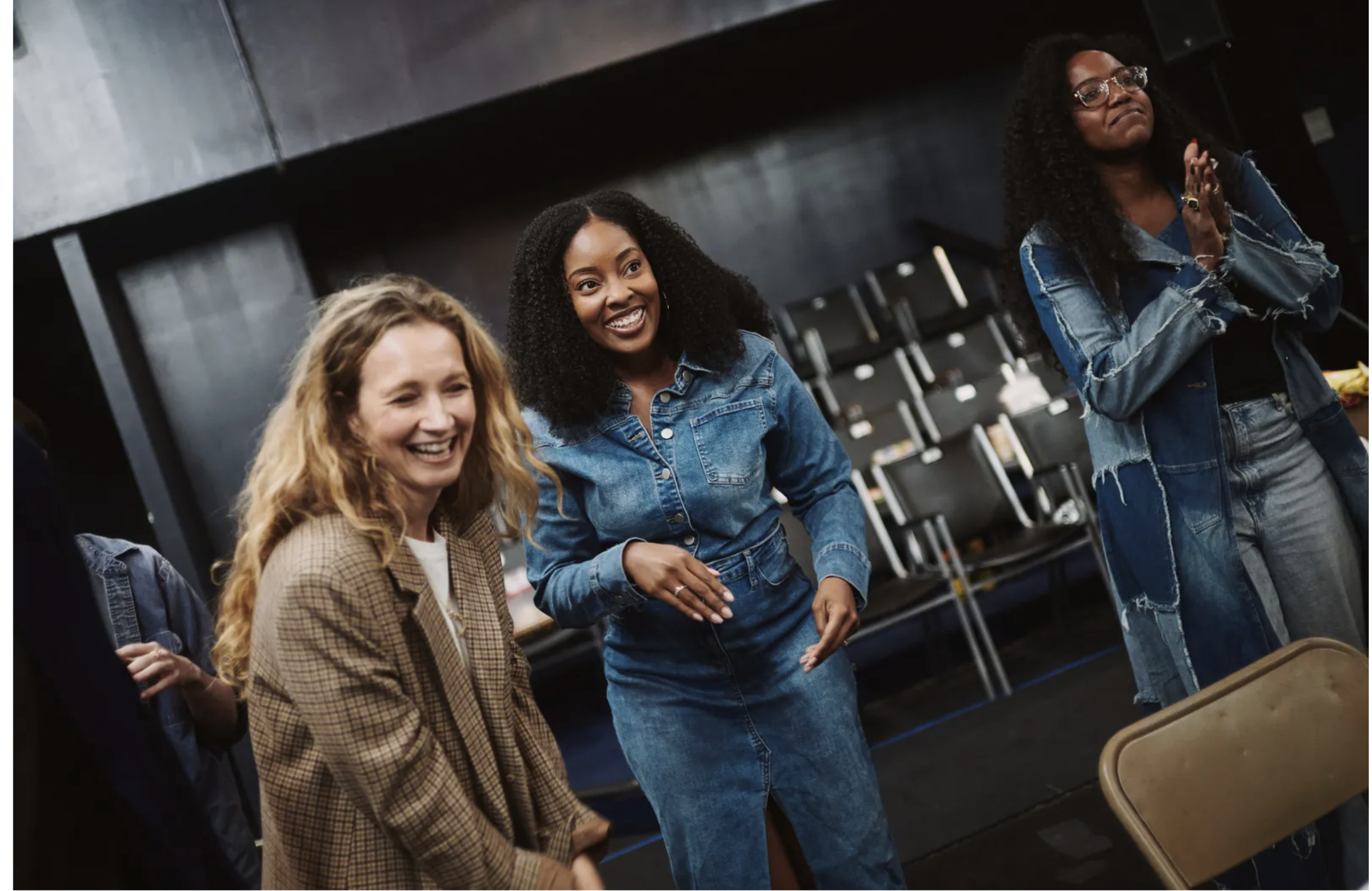
Originally published on Vogue.com October 25, 2025
View this story online
It took 15 years for Liberation to open on Broadway, but playwright Bess Wohl knows it’s finally the right time.
Wohl had workshopped her play—an exploration of the Second Wave feminist movement through one woman’s relationship with her late mother—for more than a decade, but she didn’t feel satisfied until she framed it around a series of consciousness-raising group meetings. After she began interviewing former activists who had attended those meetings, her first draft was completed within 10 days.
“Those women—I actually had a vision of them sitting in a room, waiting for me to start listening to them,” Wohl says during a break from rehearsals at the James Earl Jones Theatre. “I know it sounds kooky, but they were like, ‘Whenever you clear your schedule…’ Then I went to a writer’s retreat, so I had time. And they all, thank God, were still in the waiting room and they were like, ‘Okay, here we go.’”
Liberation, subtitled A Memory Play About Things I Don’t Remember, centers around Lizzie, a contemporary woman attempting to understand her mother, who recently died. Flooded with questions she never got to ask, Lizzie attempts to reconcile the woman she knew—a suburban lawyer’s wife—with her life before marriage and motherhood, when she was a radical feminist who worked as a journalist and organized consciousness-raising groups.
Played by Susannah Flood, present-day Lizzie narrates from the present, as well as acting as a stand-in for her mother in scenes from the past.
“The year was 1970,” she tells the audience. “And my mom… My devoted, dutiful mom who sewed the costumes for every school play and cooked every family dinner and did all the dishes and took me to every piano lesson and sat through it even though I was definitely not a musician— she was actually… a radical?”
A look into America’s political past, Liberation is also a personal story, inspired by Wohl’s own mother, who worked at Ms. magazine during the playwright’s youth. But the Tony-nominated playwright, who made her Broadway debut in 2020 with the comedy Grand Horizons, did not imagine her latest work would be quite so relevant today.
When Liberation opened off-Broadway in February 2025, directed by Tony nominee Whitney White, reviews were rapturous. The women’s fight against the patriarchy resonated with audiences reeling from the rollback of reproductive rights, and whose algorithms were flooded with tradwife content.
“I knew what we had, but you never know,” White says of the play’s reception. “Someone can have a message, but you have to deliver the right message at the right time. And I was like, ‘Is this the right time? Are people ready to hear this? And will they enter the story the way we’re entering the story?’ And as it turns out, it was.”
Audiences related to the story in many respects—to the anger at inequality in the workplace, the fear of losing bodily rights, the frustration with the sluggish pace of progress, and the exhaustion from the ongoing fight. In one scene, a character declares, “I am so hopeful, but I am burned the fuck out,” a line Wohl pulled from one of her interviews.
“She said, ‘By the 1970s I was burnt out on women’s liberation,’ and I thought, wow, the arc of history is so much longer than we realize,” Wohl says. “Already in 1970 women were feeling frustrated, like, ‘When is this gonna happen?’ And I think that that urgency really powers so much of the story of the play.” Present-day activists can relate: While the first Women’s March, held after Donald Trump’s presidential inauguration, counted more than half a million attendees in Washington D.C.—the largest single-day protest in US history—the 2025 People’s March, after his second victory, peaked at approximately 50,000 people.
Less than eight months passed between Liberation’s off-Broadway opening and its first Broadway performance, but the play’s timeliness has only increased, White says.
“The time feels even more right now. Like, the world is changing so much and it’s bringing so many features of the play forward. It’s like as the world evolves, the volume gets turned up on certain sections of the play for me. And last spring, I think I was just grateful that everybody was ready to have the conversation we were trying to have.”
That conversation takes place in a gym at an Ohio recreation center where Lizzie’s mother has organized a consciousness-raising group. Played by Betsy Aidem, Adina Verson, Irene Sofia Lucio, Kristolyn Lloyd, and Audrey Corsa, its members are impassioned activists. Some are single and some are married, some are queer and some are straight, and their ages range from 20-something to 60-something. Together, they talk about everything from workplace prejudice to sexual fulfillment to fantasies of spousal homicide. Their conversation is so personal that the intimacy coordinator hired to guide a scene when the cast is completely nude has also assisted with the dialogue.
While Liberation’s characters are Wohl’s creations, they were inspired by interviews the playwright conducted with activists from the Second Wave, some of whom have seen the play. Rather than idealize the past, Wohl’s intention was to depict the movement’s shortcomings as well as its strengths.
“I felt really gratified when one of the women who really affected the story, she came and said to me afterwards, ‘You put my life onstage,’” Wohl says. “She said it through tears. And we’ve had a bunch of experiences of women who lived through that time saying, to both of us, ‘How did you know what it was like?’”
Also fictionalized is a conversation between Lizzie and her late mother, during which she asks some painful questions, including if her mother regrets her choices. These aren’t clearly answered, but that’s the point, Wohl says.
“It’s like they’re on a deeper level of honesty at that point in their relationship. When you’re a little kid, your mom is making it better and maybe not always telling you the full truth of what life is going to be like, because it’s too much. But by that point in the play, Susannah Flood’s character has earned that honesty.”
Wohl’s personal journey aligned with Lizzie’s, as she found herself having similar conversations with her mother.
“Even though, in the play, the narrator’s mother has passed away, my mom is still with us, which is beautiful, because we’ve been able to go on this journey of the play together, in a way. The conversation that the narrator character of Lizzie has with her mom is something I was able to have. And she’s given me a lot of notes on the play.”
Despite the play’s timeliness, a Broadway transfer poses risks. Production costs have escalated since the pandemic, even with the New York City Musical and Theatrical Production Tax Credit being extended into 2027. The 2024–25 Broadway season was notable for its ticket prices—Othello, starring Denzel Washington and Jake Gyllenhaal, charged $921 for premium seats, and some tickets to see George Clooney star in Good Night, and Good Luck cost $825.
Liberation’s ensemble cast, led by a female director (Wohl and White are the only female writer–director pair on Broadway this season), consists of veteran stage actors, all of whom performed in the off-Broadway run.
“It does kind of feel like a miracle,” Wohl says. “It’s not the usual Broadway fare.”
Wohl and White hope that seeing the play’s reconstruction of a history that eventually repeated itself will light a fire in their audiences. White recalls rehearsing for the off-Broadway run the day of Trump’s second inauguration, saying, “Whenever we got overwhelmed, we had the gift of looking back at a group of women who are like, ‘We’re not going to stand for this. We’re going to do something.’ If they could do it—the things that protesters, activists, people did in that time—why can’t we? We’ve got to get some courage.
“We are not the first people in the history of Western society to live during a time of oppression, censorship, rolling back the funding of the arts, rolling back of public funding, all of these things,” she continues. “The play has allowed us all to look back to another time in which people were faced with these things. What are we going to do, and how are we going to do it?”