
Rose Byrne and Kelli O’Hara on Bringing a Little-Seen Noël Coward Comedy Back to Life
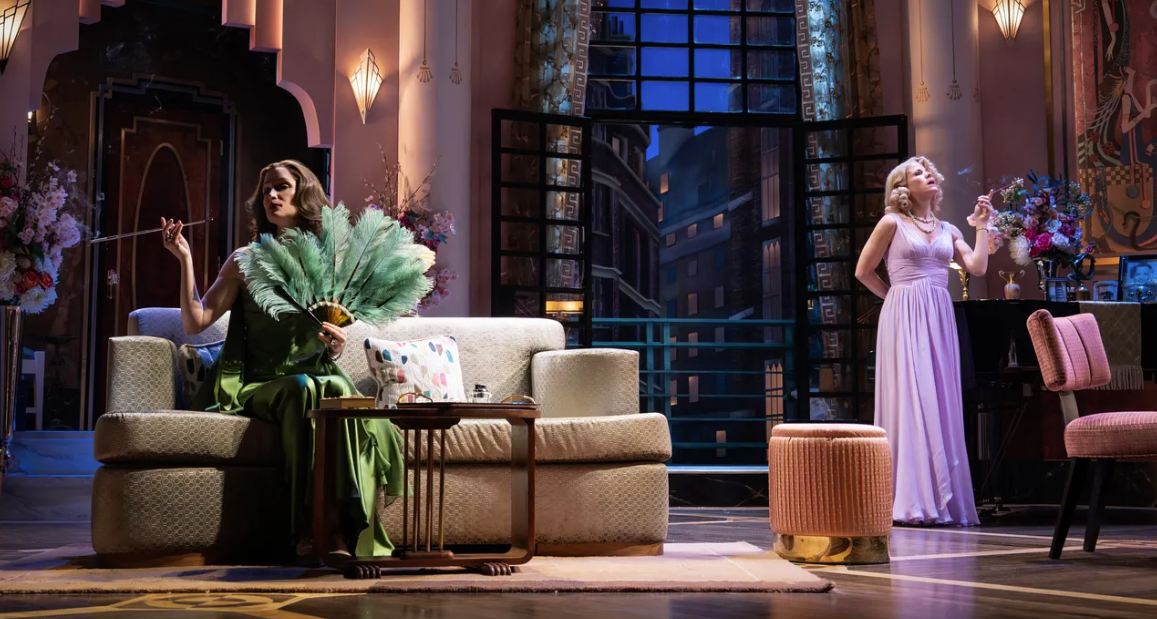
Photo by Joan Marcus
Originally published on Vogue.com
View this story online
Being pulled across the stage by a phone cord while dressed in a floor-length evening gown wasn’t originally part of the plan for Kelli O’Hara’s character, Julia, in Fallen Angels. But during rehearsals for a dinner party scene gone seriously wrong in the Broadway play, O’Hara found herself tripping over the Art Deco furniture—the only thing onstage more stylish than her dress—and sliding across the floor. Director Scott Ellis was so amused that his immediate reaction was, “We’re keeping that!”
That moment of athletic improvisation is just one of many antics O’Hara and her co-star Rose Byrne engage in during Ellis’s revival of Noël Coward’s comedy about two women and the man they both loved. Friends since childhood, Julia and Jane (Byrne) live in the same apartment building and plan to spend an idle weekend together while their husbands—played by Aasif Mandvi and Christopher Fitzgerald—enjoy a golfing trip out of town. Their peaceful lives are quickly thrown into (mostly self-inflicted) chaos, however, when they learn that a former lover, Maurice (Mark Consuelos), is set to visit them that same day.
Panicked, Jane is prepared to flee town to avoid temptation, while Julia is confident that she can resist the Frenchman’s charms. As the two debate their next move, loyalties are questioned, insults are lobbed, and several bottles of champagne are emptied. And then their husbands return.
Inspired by French farce, Noël Coward’s drawing room comedy was nearly banned from the stage for its frank portrayal of women contemplating adultery and admitting to premarital sex when it premiered at the Globe Theatre in 1925. (Two risqué jokes are told within the first five minutes of the show—and they don’t stop for the next 90.) The Lord Chamberlain’s Office, the government body responsible for policing obscenity in British theater, considered censoring the play before deciding that Julia and Jane could not actually be taken seriously, since women would never behave in such ways. Yet the humor was clearly lost on audience members who stormed out of the theater, as on critics who deemed the work “disgusting, vile and obscene.”
The production’s stunning, period-appropriate set and sumptuous costumes could not feel further from the world of Byrne’s last film, If I Had Legs I’d Kick You, an unflinching portrait of modern motherhood that earned her an Oscar nomination. The play also offers a new outlet for O’Hara, a Tony winner and seven-time nominee known for her starring roles in musicals like The Light in the Piazza and The King and I. Yet 100 later, the questions about love and sexual fulfillment raised in Fallen Angels have proven quite timeless.
“To think that there will be people in the audience even now who really can’t stand the thought of what these women are up to in this play, and especially how it ends...” muses O’Hara. (At one point, her Julia pointedly remarks on how unfair it is that “men should have the monopoly on wild oats.”) “I just love pushing on that edge,” she goes on. “I love being part of something that says, I’d like you to be surprised. If you’re still surprised, then let’s keep going. Let’s keep pushing it.’”
Coward’s insight into women’s societal repression has surprised some, given he was still in his early 20s when he wrote the play. But O’Hara credits his intuition to his childhood in the theater, where he spent a great deal of time among women who spoke freely with one another about their experiences.
Indeed, Julia and Jane discuss everything with each other—and with increasing familiarity—as they embark on what O’Hara calls “a great, saucy little night,” waiting for Maurice to arrive and happen to find them dining luxuriously in gorgeous gowns. As emotions heighten and the champagne is drained, Coward transforms the drawing room into a battleground where the women trade insults and grievances. At times, the two actresses struggle to keep from breaking onstage.
“Every single night, it’s sort of a new adventure—what someone will throw,” O’Hara says. “We’re doing something different every night. We’re just trying not to laugh at each other.”
Yet for all the show’s fizzy funniess, its more sober ideas sit just beneath the bubbly surface—among them, both women’s very real desire for attention from their husbands. “[The play] was just thought of as fiction, but I think there’s a wonderful little stab of realism,” O’Hara says. “We’re trying to tell you what we need, and you just didn’t hear it.”
It was perhaps that provocation that kept Fallen Angels from becoming a hit on Broadway in the past; its 1927 debut ran for just 36 performances, and its only revival opened in 1956.
“Rose and I talk all the time about how surprising it is, now that we’re doing it, that the play’s just not been done,” O’Hara says. “But I think it will start to be done now.”