
In a Lonely Place: Adrien Brody Brings The Fear of 13 to Broadway
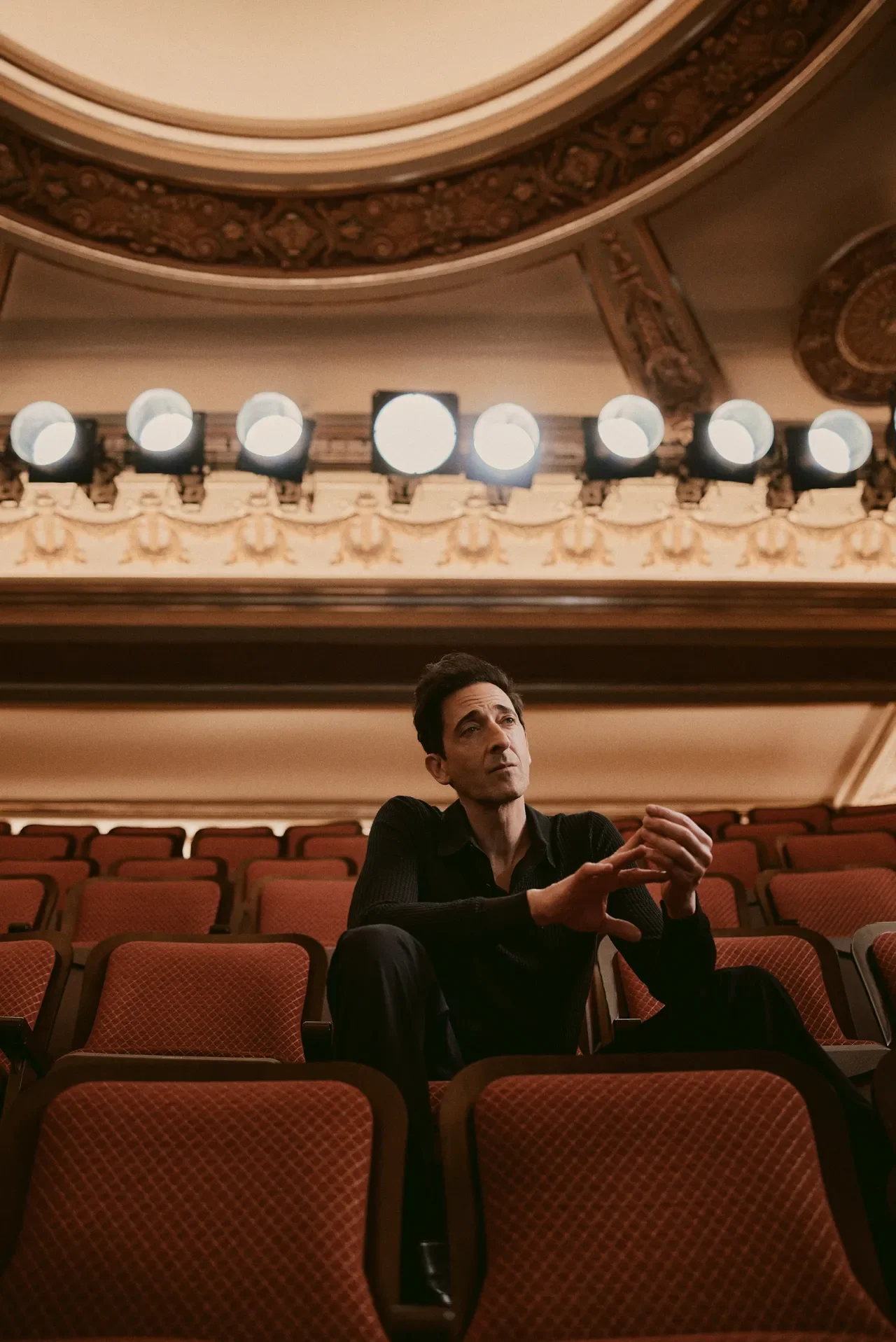
Originally published on Vogue.com
View this story online
Playing a real-life person is nothing new for Adrien Brody. The acclaimed actor earned his first Oscar for his performance as Władysław Szpilman in The Pianist in 2003, before playing Salvador Dalí in 2011’s Midnight in Paris and the titular magician in the History Channel’s Houdini: Unlocking the Mystery in 2014. Now, as he makes his Broadway debut in The Fear of 13, the man who inspired Brody’s character is often sitting in the audience.
Nick Yarris’s nightly attendance at the James Earl Jones Theatre can be credited to more than just a love of the performing arts. Written by Lindsey Ferrentino and starring Brody and Tessa Thompson, The Fear of 13 is based on David Sington’s documentary of the same name, which chronicles the 22 years Yarris spent wrongfully imprisoned for murder, rape, and abduction before he was exonerated in 2003. (The production has partnered with The Innocence Project, which is dedicated to freeing people who were wrongly convicted and was instrumental in Yarris’s case. He was the 13th person to be exonerated from death row and the 140th person in the United States to be exonerated by DNA testing following his conviction.)
“He has this unique ability to be both incredibly funny and gregarious and to access deep emotion and empathy, while also maintaining a stoicism,” Brody says of Yarris. “He’s witnessed so much. He is truly a force, and he’s quite different from me in what he exudes. His strength and his ability to persevere through so much are very present in his aura, and to have him in the audience nightly—to relate to, to call upon for inspiration—I want to truly honor him and the circumstances, and it’s enabled me to do that in a different way.”
Watching The Fear of 13 on Netflix during quarantine, Ferrentino was captivated by Yarris’s account of the decades he spent on death row. “He was able to so theatrically and vibrantly articulate his own experience, and I think a lot of that’s because he spent 22 years in solitary confinement, where his only company was books,” Ferrentino says. “He has this really unique way of speaking, unlike anyone I’ve ever met before, where he’s able to sort of paint these pictures in prose.”
Those pictures include a vivid portrait of the isolation and silence that Yarris filled with reading until he met Jacki, a volunteer with the Western Pennsylvania Coalition Against the Death Penalty who visited inmates to offer emotional connection and support. Directed by David Cromer and featuring an ensemble cast that performs the roles of Nick’s childhood friends, his fellow inmates, and his legal team, The Fear of 13 offers an unflinching look at America’s system of injustice.
That story resonates differently on Broadway than it did in London, where The Fear of 13 premiered at the Donmar Warehouse in October 2024 (earning Brody an Olivier nomination)—and where the death penalty has been abolished since 1965. “There’s a different level of complicity on the part of the audience, and anger,” Ferrentino says. “The story is new, but it is not new to people. The way that the system is designed is that when people are ‘put away,’ that is both literal and metaphorical, so that you don’t have to think about these stories. But we are all a part of this system. We’re all complicit in living in a country and a culture that creates stories like Nick’s.”
Exploring the complexity of Nick’s character—who was not guilty of the crimes he was imprisoned for but did break the law in other ways—deepens the character’s humanity and emphasizes the ways the system dehumanizes those convicted.
“That character is not a saint,” Cromer says. “He’s not a perfect person. That doesn’t mean he should die on death row. There’s an enormous ambiguity to all of these people.”
A crucial part of Nick’s story is Jacki. In her Broadway debut, Thompson is also bringing a real person to life onstage, though she’s never met the inspiration for her character because Yarris strove to protect her identity when filming the documentary. Thompson’s performance of Jacki’s journey “from curiosity to compassion,” as she puts it, is inspired by the actress’s personal experiences, which were similar to her character’s: a few years ago, she volunteered to speak on the phone with an inmate. The experience was eye-opening, and the timing of Ferrentino’s play was fortuitous.
“There were so many things I didn’t know,” Thompson says. “At that time, I didn’t realize how prohibitively expensive it would be for an inmate to keep in touch with friends and family—how, for some people, that would make it impossible to speak very often or to accept the collect call fees.”
It was also infuriating. “Any time I’ve been able to have a window into what it’s like inside this system, I feel so enraged,” Thompson continues, “and I feel like it’s this kind of stain on America and on its dreams of having an equitable and free society.”
Since joining the play’s cast, she has pursued in-depth, first-person research, talking with other prison volunteers and reading firsthand accounts from inmates. This dedication is shared with Brody, and Thompson credits the strength of their performances to their passion for the subject.
In her work, Ferrentino has often explored politics through humanity. She has addressed physical and emotional PTSD in veterans in Ugly Lies the Bone, family complications in Amy and the Orphans, and school shootings in This Flat Earth. The goal, she says, is to inspire empathy—itself a central theme of The Fear of 13.
“On one hand, from the outside, if you hear of a woman who’s a PhD student falling in love with a convicted rapist and murderer on death row, most of us have a huge amount of baggage and judgment about that,” Ferrentino says. “On the other hand, the rarity of sitting across from any person with no distractions—no phones, no computers—and purposefully withholding judgment about who they are is striking. That’s a conscious choice made by the people who come to visit, greeting the person as they are today.” Nick and Jacki were married for nine years as they fought for his exoneration—nine years during which they never touched, except to exchange rings during their wedding.
Before doing The Fear of 13 in London, Brody hadn’t acted onstage since he was 12, and he wasn’t looking for a theater role when Ferrentino contacted him. But reading her script changed his mind. It also changed her process, as the two began closely collaborating on both the performance and the script.
“[Working with Brody] sort of changed my whole writing process and my relationship with actors, and how I am able to tailor roles for them,” Ferrentino says. “It’s just this deep, deep collaboration and matching of sensibilities.”
The collaboration reached such depths, in fact, that Brody contributed to the script, writing the first draft of one of Nick’s monologues—a monologue that Yarris specifically requested for the play.
“The whole last speech at the end of the play was something that I wrote, and it is one of my favorite things I’ve written,” Ferrentino says. “We had gotten a note—I won’t say from whom—but to cut that whole speech, and Adrien fought to keep it in the play. Every time he performs it, I’m so moved and grateful to him for helping preserve that piece of writing, and for how aligned we are in protecting the integrity of the work.”
Speaking those words every night is a responsibility, Brody says, and also a privilege. “I find there to be great value in doing work that inspires us and others to communicate better and to find common ground, or to see outside our own circumstances or judgments,” he says. “I think the beauty of film, the beauty of art, and the beauty of work on the stage is that these things can plant a seed—for less judgment, for being more open-minded, or for reminding us of our own good fortune.”