
Chess
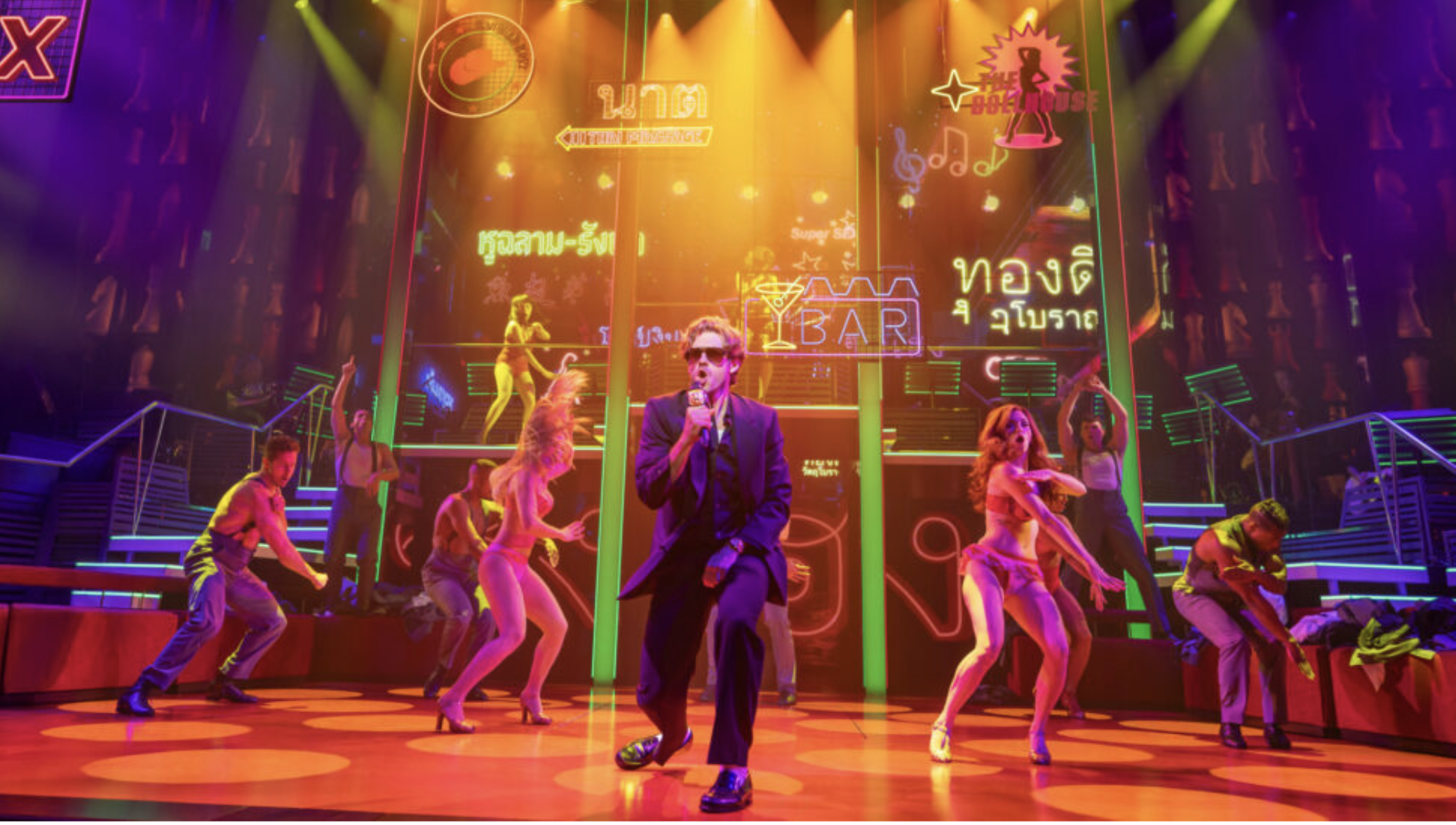
Photo by Matthew Murphy
Published January 20, 2026
One night at Chess will make a critic crumble
The songs are great but the book’s unwieldy
The story’s still a huge confusing jumble
Should be a concert staging ideally
It might be time to declare, “Checkmate.” After four decades, numerous rewrites and endless concerts, Chess has returned to Broadway. But despite the devotionbehind the seemingly neverending attempts to make the show work, it still doesn’t.
The Cold War-set musical about a world chess championship and the relationships behind the scenes first opened on the West End in 1986. It moved to Broadway, after substantial rewrites,where it ran only after 17 previews and 68 regular performances. The problem, everyone said, was the book.
“That the evening has the theatrical consistency of quicksand - and the drab color scheme to match - can be attributed to the fact that the show's book, by the American playwright Richard Nelson, and lyrics, by Andrew Lloyd Webber's former and cleverest collaborator, Tim Rice, are about nothing except the authors' own pompous pretensions,” wrote Frank Rich in the New York Times.
Chess’ score, featuring music by ABBA songwriters Benny Andersson and Bjorn Ulvaeus and lyrics by Tim Rice, is beloved, including the pop hit “One Night in Bangkok” and audition favorites “Someone Else’s Story” and “I Know Him So Well.” But the book, a tangled politicalallegory,has never coalesced as a cohesive narrative with clear characterization.A 2003 Actors Fund concert, featuring Josh Groban and Adam Pascal, is a fan favorite, followed by a 2009 concert, also with Groban and Pascal alongside Idina Menzel, but a full-scale production hasn’t played New York since those few months 1988.
And it probably won’t again. The current production, with a new book by screenwriter Danny Strong, is not an improvement upon past versions.Rather than bring clarity to the convoluted plot or deepen the characters’ motivations,it piles on clumsy humor and preposterous plotlines that strain willing suspension of disbelief to the breaking point.
The story follows two chess masters facing off at the world championship. The American, Freddie Trumper (Aaron Tveit), isnarcissistic and volatile, known for his explosive outbursts, while the Russian, Anatoly Sergievsky (Nicholas Christopher) is deeply depressed. Freddie’s second and lover, Florence (Lea Michele) is a Hungarian chess genius who manages his moods, medications and public image and who connected romantically with Anatoly years before.
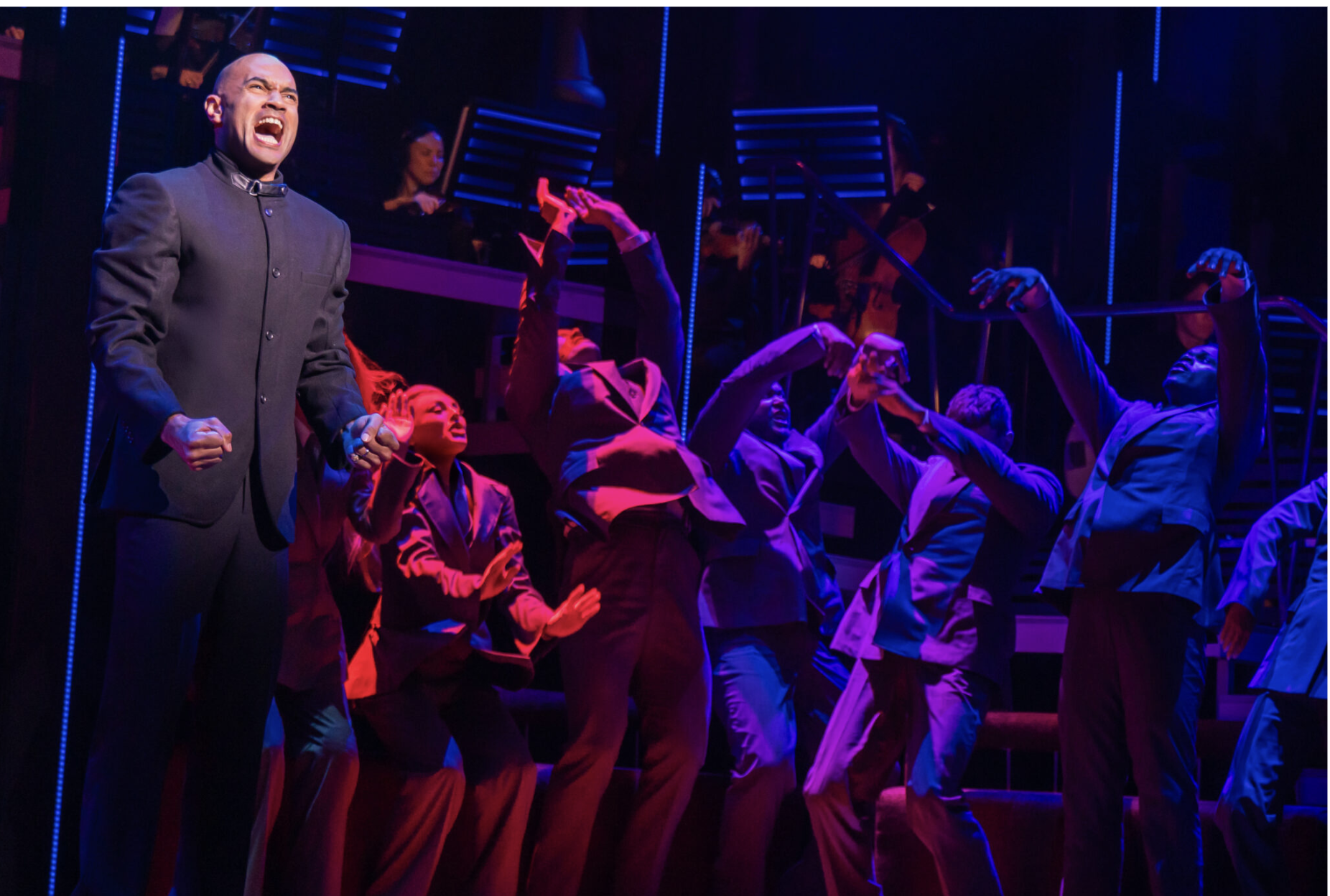
Photo by Matthew Murphy
The love triangle is a holdover from the original production, but Strong has reworked the political symbolism to a heavy-handed story lacking in any subtlety. Rather than depicting the chess tournament as a metaphor for the Cold War era-politics, it is presented as a dealmaker or breaker in actual Cold War strategies. The first act, set in 1979, centers around the Strategic Arms Limitation Talks (SALT) and the second act includes the Able Archer nuclear war scare of 1983. Anatoly’s life, in the hands of the KGB, depends on his success. The plot thickens when his coach Alexander Molokov (Bradley Dean) and CIA operative Walter De Courcey (Sean Allan Krill) conspire together for what could be catastrophic outcomes..
It’s confusing, but rather than improve the story’s focus or clarity, Strong opted for an ineffective short cut: he wrote a narrator into the show. The Arbiter, played by Bryce Pinkham, is saddled with some of the worst lines of the night, including cringe-worthy jokes about Freddie’s last name, RKF’s brain worm and Joseph Biden’s re-election campaign. Along with inspiring an equal number of laughs and groans, he provides commentary on the show, in short, instructing the audience in how to react to each scene rather than trusting their ability to interpret the show themselves. When introducing his solo, “The Arbiter,” he informs the audience, “…which yes, means I’m going to sing. And yes, I’m going to crush it,” before performing the song in such an exaggerated manner (including an air-guitar solo), it’s uncomfortable to watch. Pinkham, whose subtle comedy was so well-suited in A Gentleman’s Guide to Love and Murder, does not achieve that same arch or wit in Chess.
He does sound great, as does the entire cast. Christopher, who was brilliant as Pirelli in Sweeney Todd, brings a hint of that humor to his tortured character, and his thundering performance, especially the Act One closer “Anthem,” is nothing short of stunning. Tveit’s easy charm is an asset to Freddie who, through repeated clumsy mentions his pills, is written to be narcissistic and bipolar, and Tveit’s charisma helps to explain why Florence stayed with him for so many years. His performance of “Pity the Child,” in which he shares his traumatizing childhood, is thrilling.
It’s no surprise that Michele, returning to Broadway after her star turn in Funny Girl, sounds amazing, belting to the rafters in “Nobody’s Side” and musing on love in “Heaven Help My Heart,” but there is little chemistry between her and either of her paramours. Florence is a character who keeps her cards close to her chest, which often leaves Michele with little to do. Even less motivation is created for Anatole’s estranged wife Svetlana (Hannah Cruz, fierce in red leather and heeled boots, in case we couldn’t see that he has an agenda.)
Given the lack of subtlety in the writing, Michael Mayers’ scaled-down staging is surprising. There are few props on David Rockwell’s set and even less scenery other than Peter Nigrini’s videos. While the opening scene, which features the song “The US vs USSR” with the Pinkham and the suit-clad ensemble channeling David Byrne while performing Lorin Latarro’s choreography, lit by Kevin Adams, was promisingly ominous, the following 2 hours and 20 minutes did not fulfill. The chess matches, an opportunity for Lotarro’s choreography to shine with ensemble members dancing as the pieces, are instead presented with the two men facing the audience and narrating their plays alongside their inner monologues.
“I was the US champion at age 11,” Freddie thinks. “My mother should’ve locked my chess board away. I hate chess. I hate my life. I wanna die—” While Anatoly muses, “I wanna die. I don’t know my children or my wife. I never have. Just as my parents never knew me.”
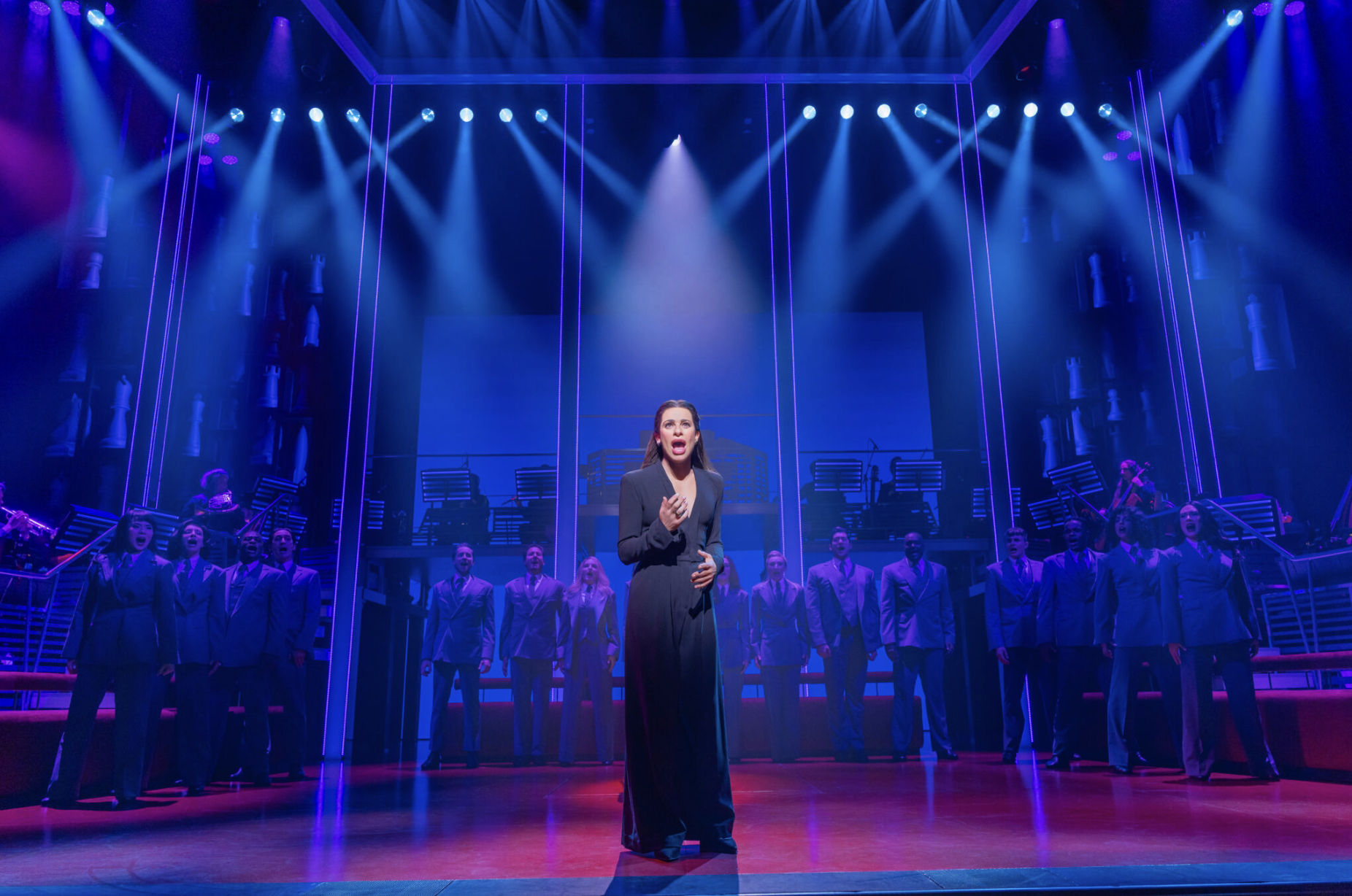
Photo by Matthew Murphy
Neither Florence nor Svetlana are provided with such insight, and their motivations are frustratingly unclear. Does Florence really believe she’ll be reunited with her long-lost father? Does Svetlana still love Anatole, or are her actions politically motivated? This lack of depth clashes with “Someone Else’s Story” presented as the eleven o’clock number. Chess and politics have been written as the main conflict, not Florence’s love life, and the song isn’t provided any context with book scenes. Michele performs it simply by walking centerstage and beginning to sing, like she’s competing on American Idol rather than playing a character in a musical. She sounds amazing but there is no payoff. It’s ironic that the women are given so little to work with, given the queen is the most powerful piece in the game of chess.
To successfully play chess, one must be able to think visualize the opponent’s future moves. In another 40 years, it’s unlikely that another revisal of Chess will be on Broadway.