
How Aleshea Harris Took ‘Is God Is’ From Stage to Screen
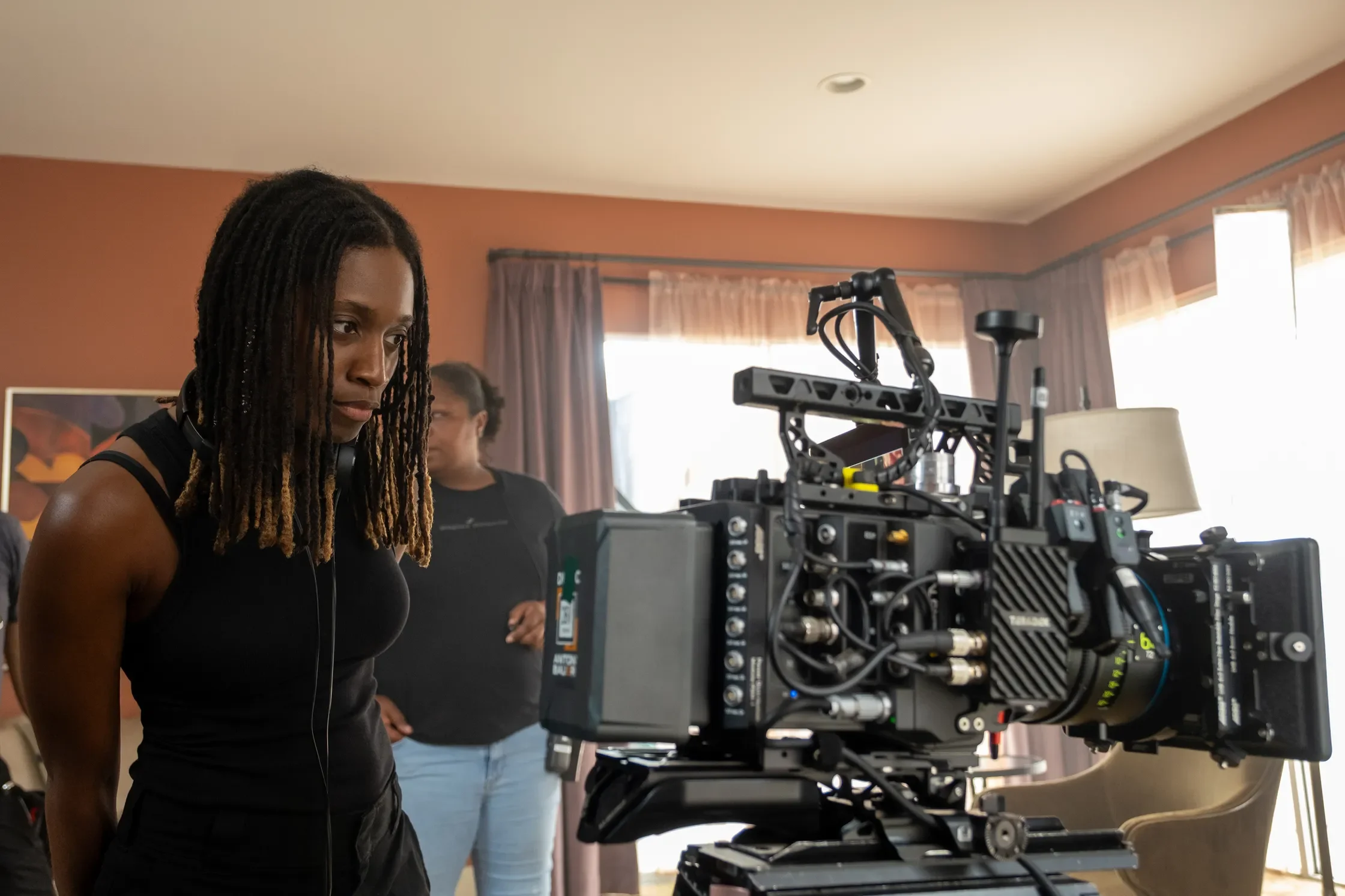
Director Aleshea Harris on the set of her film Is God Is.
Photo by Patti Perret
Originally published on Vogue.com
View this story online
Is God Is, playwright Aleshea Harris’s epic tale of family trauma and vengeance, is also a story of feminine strength. It was only appropriate, then, that Harris adapt it herself.
“It was baptism by fire,” the Pulitzer Prize finalist says of writing and directing the play’s new film adaptation, out May 15, which happens to both begin and end with conflagrations.
Following twin sisters on a cross-country mission of revenge, Harris’s play premiered Off Broadway in 2018 to critical praise and multiple extensions. It had always been Harris’s plan to turn the work into a screenplay, but it was only at the urging of her friends and colleagues that she stepped behind the camera. “As a playwright, I have really strong ideas, probably to the frustration of some directors I’ve worked with, about how things should be performed,” Harris says. “It’s really because of the women around me, who believed in me, that I was able to do that. By the time we were pitching to the studio, it was kind of a package deal.”
Her female support off-screen reflected the relationships onscreen in Is God Is, which centers on sisters Racine, a.k.a. the Rough One (Kara Young), and Anaia, a.k.a. the Quiet One (Mallori Johnson). Scarred, both physically and mentally, from a brutal attack by their father, the sisters receive a surprise summons from their mother (Vivica A. Fox) to hear her dying request: “Make your daddy dead. Real dead.”
It’s a sudden serving of generational trauma for the women. Growing up in foster care, Racine and Anaia thought they were parentless. But Ruby—or God, as Racine refers to her—was only protecting her children from their father, who had drenched her in alcohol and lit her on fire. (The girls’ scars come from trying to put out the flames.) God’s deathbed request sets them on a road-trip adventure of sweeping proportions as they find themselves battling against one form of patriarchy or another. As Racine tells Anaia, “This is some destiny type shit.”
While writing, Harris knew the sisters had to be twins. “There’s inherent drama, I think, with twins. There’s also something that feels mythic about twins. They feel sort of magical and unusual.” It’s in their long journey into the South—by car, then bus, then on a very long walk—that the fissures in the sisters’ relationship begin to show. Long two codependent halves, they begin to assert themselves as individuals on the road—an idea that Harris delighted in exploring visually.
“Some discoveries that I made [while adapting] were really in deepening who they were,” Harris says. “I understood better in the movie than I did in the play that secrets needed to come to the fore. What I really found with the movie, for Anaia, is her observation and posture toward her sister and her living the life she lives in reaction—not just to the scars on her face, but to who her sister is—and vice versa with Racine. I understood the way that she positioned herself based on her sister’s position in the world.”
The mirrors that the sisters had held up for one another shatter, especially as Racine discovers her appetite for violence. Actions that to her feel justified begin to trouble, and then alienate, her sister. “I thought about the pain for Racine—how she thinks of Anaia as turning on her, in a way,” Harris says. “But I think that moment, thinking about how they journey and where they go, of her pain: ‘Why don’t you understand that I’m doing this because a terrible thing has been done to us? I’m not the monster.’ She literally says, ‘You’re looking at me like I’m the monster.’ I hadn’t thought as much about what it would mean to her to have the one person, her one ally, sort of turn on her.”
The culture has also shifted a bit since Is God Is played onstage; in the era of the manosphere, the work’s engagement with violence against women—and misogynoir in particular—feels especially timely. “In my feed, there has been a lot about the acts of femicide specifically against Black women,” Harris says, “because it’s still a bit taboo to call out violence against Black women that’s perpetrated by Black men. That’s a very gnarly conversation that I think people are wanting to have for the betterment of the entire community and for the love of all Black folks.”
She goes on: “I know the ways that we are pathologized, and I know that our pain just isn’t taken seriously in the culture. This comes from having intimate knowledge of it and feeling like people don’t want the anger. It’s the trope of the angry Black woman, but people aren’t really interested in where that anger comes from, and then there’s the new trauma of having a horrible thing happen and having people dismiss you. And this applies to all women across the globe in so many different spaces. It’s like we have a mark on our heads when we’re born.”
Racine and Anaia bear that mark as survivors, not victims—and survivors with the opportunity to put an end to their father’s violence for good. But just as important to Harris was exploring the high price of getting even.
“I actually am not an advocate for getting revenge,” she says, citing women in her family who have wanted to avenge the terrible acts of men but opted instead to exercise a restraint that Harris found “inspiring.”
“What I’m interested in sitting with, in addition to revenge, is what the cost is to the person who wants to wreak that havoc,” Harris continues. “If you’ve already been harmed, part of what I’m interested in, especially for myself very personally, is how do you wear that wound and keep going? How do you not let it stop you from achieving your dream and having joy in your life?”