
Angry Alan
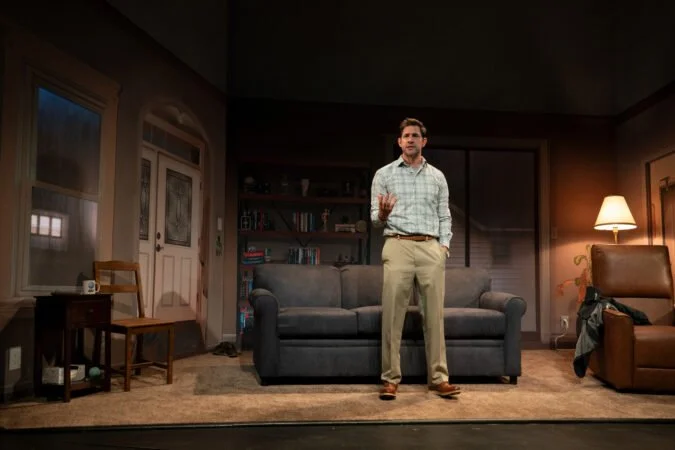
John Krasinski in Angry Alan
Published July 5, 2025
Roger is the first to tell you, he’s a good guy. The main character and narrator of Penelope Skinner’s play Angry Alan makes his child support payments to his ex-wife on time, even though he was unfairly fired from his cushy corporate job at AT&T. He loves his teenage son and can’t wait to take him fishing soon. He supports his live-in girlfriend’s artistic pursuits, even though her classes involve sketching nude men.
As Roger tells the audience (although it’s never explained why he is talking to us), from his comfortably generic middle-class home, things were fine, until his content complacency is disrupted by the discovery of Angry Alan. An online personality in the style of Jordan Peterson or Andrew Tate, the play’s title character is devoted to persuading his many followers that men are the real victim of present-day societal structures that have resulted in a “gynocracy.”
Roger’s (proudly self-described) first moment of red-pilling is thanks to a few simple words he sees online: “men are intrinsically good”. It’s the world around them that has changed, stripping them of their inherent rights and values and labeling masculinity as a crime. Roger is rapidly drawn in, sending the video to his friends and family, spending hours on his phone or laptop and eager to “teach” his girlfriend about his newfound discoveries about “the hypocrisy of the modern woman”.
It's easy to see why Roger would be an easy convert. A middle-aged white man in Middle America, he is a dairy manager at a supermarket, often forced the work the graveyard shift, and is estranged from his teenage son. His girlfriend spends her free time with feminist friends from art class, and his closest friend was recently fired for telling a crass at an office Christmas party. “Because feminism was so successful, things have gone a little too far the other way,” Roger informs us sincerely.
I want to roll my eyes as I type these words. Poor Roger, I think sarcastically. I’ve heard these empty complaints many times before. But this production impact—and it does have one—lies on the broad shoulders of its star, John Krasinski. The embodiment of the affable nice guy—I haven’t seen a single episode of The Office and even I can say that—Krasinski chronicles Roger’s conversion in a friendly, bewildered manner that, while impossible to empathize, makes listening to for ninety minutes bearable.
And yes, some of the facts Alan disperses are true. More women are graduating from college than men. Men are suffering from depression and are often uneducated in how to cope in healthy ways. Despite some societal shifts, men are often still expected to be a provider for their families. And directed by Sam Gold, Krasinski’s intrinsically lovable energy masks the threat of danger pulsing underneath the “I’m just asking questions” attitude that Angry Alan proselytizes. It’s even almost understandable how his narcissism and disenfranchised victimhood dictates his life’s narrative. His wife’s postpartum depression was really hard on him, he tells us. Oh, and her, too. And he hasn’t spoken with his son in eight months, but “no one will tell me why.”
Roger’s converter’s zeal quickly sends him down a slippery slope as he empties his bank account and neglects his child support payments to attend a Men’s Rights conference in Detroit where he proudly wears his golden nametag that signifies how much money he’s donated to Alan’s “cause.” While the speed of his conversion seems extremely quick, his hunger to find an explanation for the bewilderment he feels is almost understandable. How can a progressive woman love the work of Picasso, knowing how he treated the women in his life? Why are people sexually aroused by 50 Shades of Grey’s “pervert with a torture chamber” instead of a “sensitive guy” like him? How could a company he had given the best years of his life fire him just like that?
Despite the cruelty and hatred in Roger’s words, there are moments of humor, notably Krasinksi’s bewilderingmemory of finding his girlfriend “frothing oat milk” in their kitchen. But most of the laughter is in sympathy or discomfort rather than actual comedy. His observation that a woman sure walks fast while crossing a parking lot with him is pathetic as we witness his oblivion to her fear of him assaulting her in the dark.
As Roger’s narrative builds to a painful confrontation with his child, it’s crucial to remember we’re only hearing his interpretation of everything. Performed on dots’ set in Qween Jean’s Everyman costume of a blue checkered shirt and crisply ironed, though poor-fitting khakis and lit by Isabella Byrd, at times Angry Alan resembles a TED Talk, with projected photos (designed by Lucky Mackinnon) of the various people in Rogers’ life accompanying his monologue. It’s telling that his first memory of his current girlfriend resembles a model’s headshot, while his ex-wife is shown with a judgmental, disapproving expression.
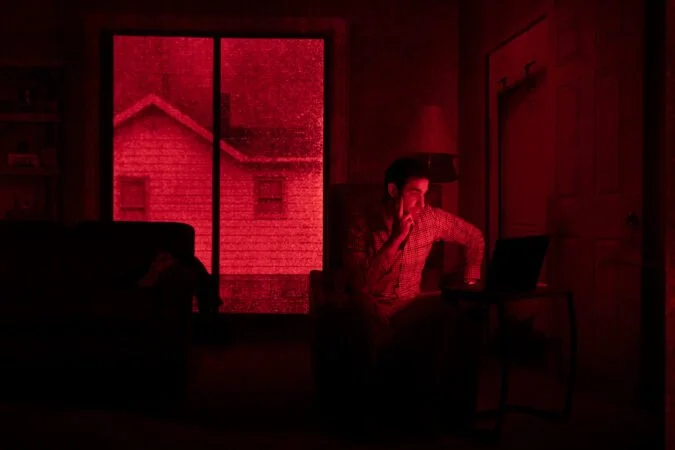
After such a buildup—essentially 90 minutes of mansplaining—Angry Alan’s conclusion feels slightly rushed and too neatly tied up, but its final image of Roger alone in the glow of his laptop, leaves a lasting impression of isolation in the Internet age. But it’s also clear Roger only has himself to blame.
Published July 5, 2025